The continuity decision
For supply-chain, procurement and risk teams, critical tooling continuity is not only a technical question. It can affect service continuity, recovery time, constrained supply, customer commitments and brand trust. The useful decision is whether the proposed product, supplier and evidence route is strong enough for the intended market and channel—not whether another document can be added to the file.
Gnik’s role in execution
Gnik can coordinate supplier dependency information, order exposure, alternative-source evidence and recovery actions within the sourcing programme. The buyer retains risk acceptance, allocation policy and formal business-continuity governance.
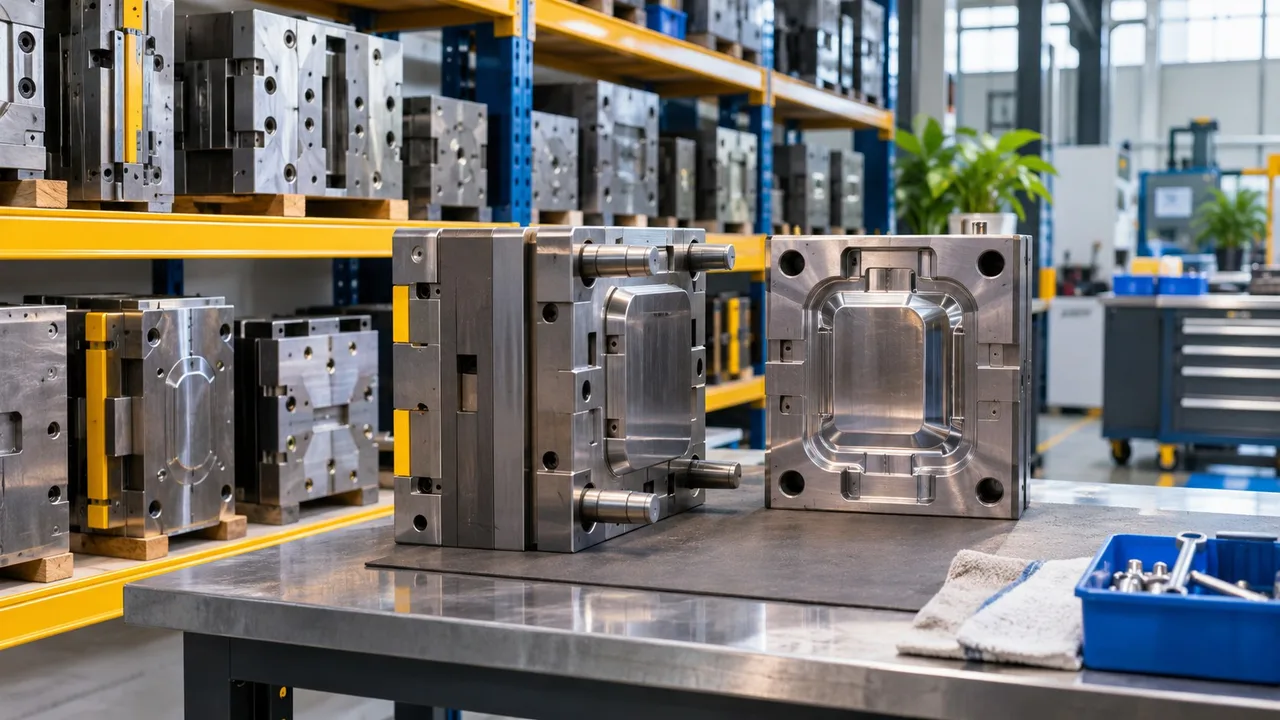
Tooling is often visible in the commercial agreement but invisible in continuity analysis. A buyer may have paid for a mould without knowing whose site holds it, whether it is insured, whether it can fit another machine, or whether the latest drawing and programme exist outside one technician's laptop. When the factory, toolmaker or supplier relationship fails, legal ownership alone may not create physical access or usable production capability.
The control problem spans commercial rights, engineering, configuration, quality and recovery. ISO 10007 provides guidance on configuration management, while ISO/TS 22318 connects supplier relationships to continuity strategy. The practical objective is not to duplicate every asset. It is to identify which tools can stop a critical product and select protection that fits their failure modes and recreation time.
Build a tooling register that can support a recovery decision
Give each product-specific asset a stable identifier and link it to product families, parts, cavities or operations. Record supplier, legal owner, physical custodian, facility, machine interface, dimensions and weight, lifting points, utilities, current drawing and programme revision, output history, remaining-life assessment, maintenance, critical spares, insurance and access conditions. Photographs help identity but do not replace dimensional and technical records.
| Register field | Continuity question | Evidence |
|---|---|---|
| Ownership and access | Can the asset lawfully and physically be recovered during dispute or insolvency? | Contract, marking, acknowledgement and release route |
| Location and interface | Can it move to a compatible machine and site? | Facility, machine envelope, mounting, services and transport study |
| Condition and life | Will it produce conforming output after storage or interruption? | Maintenance, shot or cycle history, inspection and retained samples |
| Technical baseline | Can the tool be repaired, duplicated or set correctly? | Controlled drawings, materials, tolerances, programmes and setup sheets |
Determine criticality from consequence and recreation time
Assess how quickly loss of the tool affects a prioritised product, how much usable stock protects the gap, and how long repair, retrieval, replication, installation and qualification would take. Include the specialist toolmaker, raw tool steel, texture, coating, heat treatment, gauge and trial capacity. A modest jig can be more critical than a costly mould if it has no drawing, is needed for every unit and takes months to rediscover through trial.
- Identify single assets serving several parts, variants, customers or supplier sites.
- Separate ordinary wear spares from catastrophic-loss protection.
- Consider gauges, test fixtures, patterns and software keys that can block release even when production tooling survives.
- Check whether the original toolmaker, special material or proprietary controller is itself a single dependency.
- Calculate end-to-end recreation time through first conforming output, not only machining time.
- Record confidence where ownership, condition, drawings or cycle history cannot be verified.
Choose the protection strategy by failure mode
| Strategy | Best fit | Control needed |
|---|---|---|
| Preventive maintenance and spares | Wear, minor damage and known consumables | Usage triggers, competent service and verified spare fit |
| Technical-data recovery | Repair or recreation is feasible inside the window | Current drawings, materials, programmes and change history |
| Duplicate tool | Loss consequence exceeds duplicate and qualification cost | Independent location, correlation and periodic condition |
| Transfer-ready original | Tool can move faster than it can be recreated | Access rights, compatible site, logistics and rehearsed setup |
| Product or process redesign | Asset is inherently fragile or obsolete | Controlled validation and commercial transition |
A duplicate is not automatically independent. Two tools in the same hazard zone, maintained by the same unavailable specialist or dependent on the same unlicensed programme can fail together. Conversely, a robust data pack and qualified toolmaker may be sufficient for a non-critical asset with long inventory protection. Document why the selected strategy closes the measured continuity gap.
Make ownership executable
Contracts can address title, identification, permitted use, maintenance, insurance, inspection, movement, lien risk, subcontracting, return condition and access on termination or specified continuity events. Local law, insolvency rules, landlord rights and customs may affect enforcement, so obtain competent legal advice. Operationally, confirm that the physical mark matches the register and that supplier and buyer records agree.
Predefine the authority and contact route for emergency access. A clause buried in a contract will not arrange a crane, export document, safe decommissioning or border clearance. Identify who pays, who insures the movement and who approves release from active production. Do not attempt unsafe or unauthorised removal during an incident.
Control the technical data as a product configuration
- Store approved drawings, tolerances, materials, treatments, texture, cooling or feed details and revision status.
- Preserve machine and controller programmes in a secure, recoverable form with lawful access.
- Link each approved product sample and test result to the tool, cavity and process version that produced it.
- Require tooling repair and modification to enter normal engineering change control.
- Keep setup, maintenance and inspection records intelligible to a competent alternate team.
- Test retrieval and readability; a backup that cannot be opened or interpreted is not recovery data.
Supplier intellectual property and buyer-owned product information may coexist in the technical pack. Define rights and protection rather than assuming that payment for the physical tool transfers every design or programme. Use controlled access, escrow or independent custody where proportionate and legally sound.
Prove transfer or duplicate readiness
For critical assets, run a controlled transfer study or practical trial. Confirm lifting and transport, packaging, preservation, machine compatibility, utilities, installation, alignment, calibration, process settings, first-off inspection and representative output. Correlate duplicate cavities or gauges to approved product characteristics. If a full physical move would create excessive risk, test the uncertain interfaces and retain an engineering plan for the rest.
| Trial checkpoint | Pass evidence | Failure response |
|---|---|---|
| Asset receipt | Identity, condition and preservation confirmed | Quarantine, photograph and assess before installation |
| Installation | Interface, services and safety checks complete | Engineering correction through controlled change |
| First-off | Critical product and process characteristics pass | Adjust within authority or stop and escalate |
| Representative run | Stable output, yield and cycle demonstrated | Revise capacity and recovery estimate |
| Return or storage | Condition and records restored | Repair and revalidate readiness status |
Monitor degradation and change
Use cycle or usage counts, preventive-maintenance status, critical dimension checks, defect trend and toolmaker findings. Review continuity protection after product changes, tool repair, machine replacement, supplier move, new variant or changed recovery objective. Verify the physical asset periodically. A register can show ‘available’ long after a tool has been modified, cannibalised, moved or worn beyond economic repair.
The sourcing principle
Tooling continuity works when commercial rights, physical reality and technical knowledge describe the same asset. Protect the few tools whose loss exceeds the recovery window, then prove that the chosen route—repair, recreation, duplication or transfer—can reach conforming output. That is a stronger control than either a title clause or a spare tool viewed in isolation.
How Gnik can move this decision forward
Gnik can help buyers establish tooling records, reconcile supplier and product data and coordinate readiness or transfer evidence. Engineering, quality, legal and safety authorities retain approval of tooling changes, access and production release.
Practical next step: send Gnik the critical-product list, supplier route and current recovery assumptions. Gnik can help turn it into a dependency, evidence and continuity-action map before quotation, sampling, order placement or shipment release, as applicable.