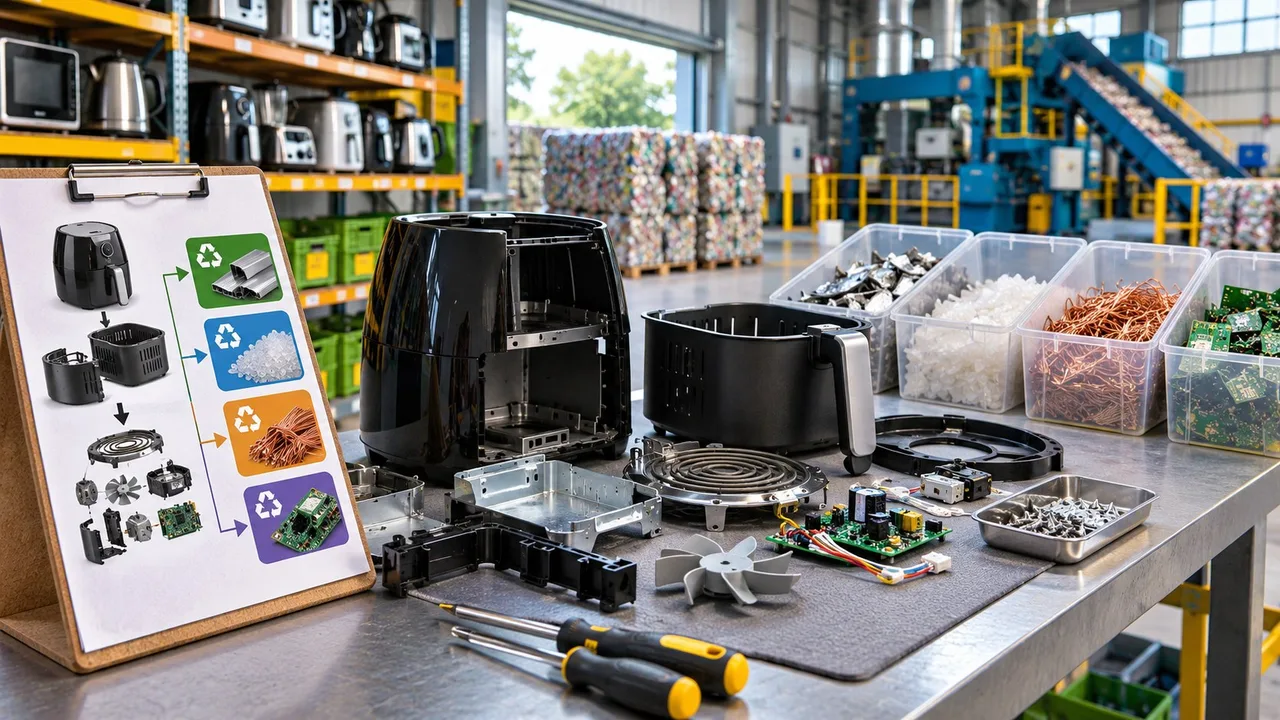
The lifecycle-value decision
For product, service, sustainability and commercial teams, end-of-life product instructions is not only a technical question. It can affect repair cost, returns, spare-part exposure, recovery value, customer experience and circularity claims. The useful decision is whether the proposed product, supplier and evidence route is strong enough for the intended market and channel—not whether another document can be added to the file.
Gnik’s role in execution
Gnik can carry lifecycle, repair, packaging and reverse-flow requirements into supplier development and evidence collection. The buyer retains responsibility for service policy, environmental claims, waste obligations and market-specific compliance decisions.
At end of use, customers often see several conflicting signals: a crossed-out bin, a plastic code, a battery warning, a website recycling statement and no practical collection route. Some follow the easiest instruction, while others dismantle a product in a way that exposes sharp edges, stored energy or personal data.
The EU waste and WEEE frameworks distinguish waste prevention, reuse, collection and treatment responsibilities, while ISO 14021:2026 addresses substantiation of self-declared environmental claims. Product-specific and national rules vary. Instructions should be designed from verified destinations and current legal duties rather than copied from another product or market.
Define the audience, market and likely end states
Identify consumers, business users, repairers, collectors and treatment operators. Map where the product is sold and realistic routes in each territory. Distinguish end of ownership from end of useful life: a working product may be reused, while a damaged or recalled product may require a controlled route. Do not encourage donation when fitness or safety is unknown.
| Instruction layer | Audience | Content |
|---|---|---|
| Product/pack | User at decision point | Short mandatory marks and immediate safety |
| User guide | Owner or facilities team | Preparation, parts, data and route options |
| Web/QR | Market-specific user | Current collection finder and programme terms |
| Technical file | Repair or treatment partner | Materials, hazards and controlled separation |
Start with product identity and condition
Provide model, variant, power source and any serial or date information needed to locate the correct route. Ask the user to check recall or safety notices where relevant. Separate functioning, repairable, damaged, contaminated and battery-swollen conditions. The same instructions should not direct a safe working chair and a structurally failed chair to donation.
Prioritise safe preparation
Explain shutdown, unplugging, cooling, discharge, data backup, account unlinking and removal of accessible consumables where the user may do so safely. Identify sharp, pressurised, chemical, glass, magnet, flame-retardant and stored-energy risks. Do not instruct a consumer to open sealed hazardous areas or remove a battery that requires trained service.
- Use clear action verbs and diagrams for critical steps.
- State prohibited actions such as burning, crushing or ordinary-bin disposal where applicable.
- Keep warnings adjacent to the relevant separation instruction.
- Provide emergency or damaged-item routes where normal collection is unsafe.
- Translate and validate meaning in each destination language.
- Make instructions available after packaging and paper manuals are lost.
Separate reuse, repair, take-back and recycling
Explain what condition is suitable for each route. Link repair and spare information where available. State brand take-back eligibility and customer responsibilities accurately. For recycling, identify whether the whole product, battery, electronic module, textile, packaging or another component has a separate collection stream. Avoid sending mixed products to facilities that accept only one material.
Localise collection information
Use country or postcode tools, official scheme references or customer-service routes that can be maintained. State whether pickup, drop-off, fees, packaging or proof of purchase apply. Assign an owner to test links and partner status. A permanent printed address can become wrong; a QR code can also fail if the page is not governed for the product's full life.
| Claim or symbol | Required check | Common overreach |
|---|---|---|
| Recyclable | Accepted process and consumer access in the claimed market | Material is technically recyclable somewhere |
| Take-back | Active scope, geography, capacity and terms | Pilot presented as universal |
| Reusable/donatable | Safety, function and lawful onward use | Passing responsibility for a defective product |
| Zero waste/diverted | Defined boundary and verified outcome | Counting collection as final recovery |
Provide treatment information at the right access level
Professional partners may need material composition, hazardous-substance location, battery chemistry, safe disassembly, data components and fastener sequences. Use controlled technical documents and product identifiers. Protect confidential information proportionately without withholding facts needed for safe treatment or required by law.
Coordinate marks across product, pack and digital channels
Build one approved end-of-life content matrix covering product labels, packaging, manuals, product page, customer support and take-back portal. Resolve contradictions before artwork release. Keep legally required symbols distinct from voluntary claims and explain them where useful. A resin code on packaging should not be interpreted as a claim about the complete product.
Verify the downstream route
Obtain current evidence from collection and treatment partners about accepted products, exclusions, processing, subcontractors and outputs. Test the customer journey with real locations. Where facilities vary, qualify the wording. Do not tell consumers a material will become a new product unless the partner evidence supports that outcome.
Control changes over the product life
Review instructions after material, battery, supplier, market, law, programme or partner changes. Preserve support for older revisions and identify date ranges. Monitor broken links, rejected drop-offs and customer queries. End-of-life information may need to remain current long after manufacturing has stopped.
Use feedback to improve the next design
Collect reasons for disposal, failed repair, unavailable parts, disassembly difficulty and route rejection. Feed them to product architecture, material and service planning. Good instructions help the current product exit responsibly; good governance also removes the barriers from the next generation.
Test the instruction with intended users
Give users the product, current information and a realistic local context, then observe whether they choose the safe route and understand the symbols without coaching. Include older products, missing packaging and damaged conditions. Measure wrong separation, broken links and time to find a facility. Correct wording and hierarchy before publication. A technically accurate page can still fail when the customer cannot identify which battery, pack or product the instruction covers.
Archive evidence behind each statement
For every route or claim, keep the responsible scheme, facility acceptance, material scope, geographic coverage, review date and owner. Link artwork and webpage versions to that evidence. When a partner changes, update live content and preserve the historical version used for older sales. If a route cannot be substantiated, replace certainty with a precise direction to check local services rather than leaving a broad recycling promise in place.
Make the information accessible in format as well as language. Use readable type, strong contrast, descriptive links, captions and text alternatives for essential diagrams. Provide a non-digital route for users who cannot scan a code or access the site. Avoid placing critical safety only behind account login. Test customer-support staff on the same version so their advice does not contradict the product. Accessibility is part of making the intended route usable, not a decorative publishing feature.
The end-of-life conclusion
Useful end-of-life information connects a known product and condition to a safe, real and local route. Clear hierarchy, hazard boundaries, maintained digital content and substantiated claims are more valuable than a page of generic recycling symbols.
How Gnik can move this decision forward
Gnik can help buyers organise product, material and partner facts into maintainable end-of-life content while authorised safety, environmental and legal owners approve each market's instructions and claims.
Practical next step: send Gnik the product architecture, expected service model and destination markets. Gnik can help turn it into a supplier-facing lifecycle and reverse-flow requirement brief before quotation, sampling, order placement or shipment release, as applicable.