Translate technical performance into a buying decision
For category, product-development and quality teams, footwear quality testing is not only a technical question. It can affect product performance, return exposure, claim defensibility, consistency and landed commercial value. The useful decision is whether the proposed product, supplier and evidence route is strong enough for the intended market and channel—not whether another document can be added to the file.
Gnik’s role in execution
Gnik can connect the buyer’s intended use, price architecture and quality expectations to supplier-ready specifications, samples and evidence checkpoints. The buyer retains approval of the final specification, claims and market-specific compliance position.
Footwear is a system of materials that flex, compress, rub, absorb moisture and age together. A sole can meet an abrasion target and still separate from the upper. A bond can pass when new and weaken after heat or humidity. A lining can transfer colour to socks. A fashionable outsole can feel secure in one condition but should not be marketed as slip-resistant without the right classification and evidence.
A risk-based plan begins with the actual shoe: category, user, construction, material stack, use environment, care, destination and claims. It then links each likely failure to a development or compliance question, a method, a sample and an acceptance rule.
Freeze the product identity before ordering tests
- Footwear type, intended user and use: casual, fashion, children's, sports, occupational or another defined category.
- Construction route: cemented, vulcanised, moulded, stitched, welted or a hybrid, including critical adhesives and primers.
- Upper, lining, sock, insole, midsole, outsole, heel, shank, reinforcement, fastener and decoration materials.
- Last, size range, fit intention, mass and any left-right or pair-matching requirements.
- Destination labelling and chemical obligations, plus every performance claim made on pack or product page.
Testing an early sample with substitute materials can support development, but the report should not be presented as evidence for the final production shoe. Connect every result to style, colour, size, material version, factory and date. Where size influences geometry or stress, select representative sizes rather than assuming the base size covers the range.
Upper-to-sole adhesion: test the actual bond system
ISO 17708 describes a method for determining resistance to separation of the upper from the outsole, adjacent outsole layers, or tear failure in the upper or sole, and includes ageing conditions that can support production control. The result depends on materials, surface preparation, adhesive, cure, geometry and test location. Record the failure mode as well as the force: cohesive material tear and clean adhesive separation point to different actions.
| Bond question | What to review | Production implication |
|---|---|---|
| Where did failure occur? | Interface, adhesive, upper or sole layer | Correct the actual weak link |
| Did ageing change the result? | Heat, humidity or other defined conditioning | Validate shelf and transport exposure |
| Are all zones represented? | Toe, waist, heel and layered sole geometry | Avoid a strong test location hiding a weak one |
| Did material or primer change? | BOM and process version | Revalidate significant substitutions |
Flex testing: choose component and whole-shoe questions carefully
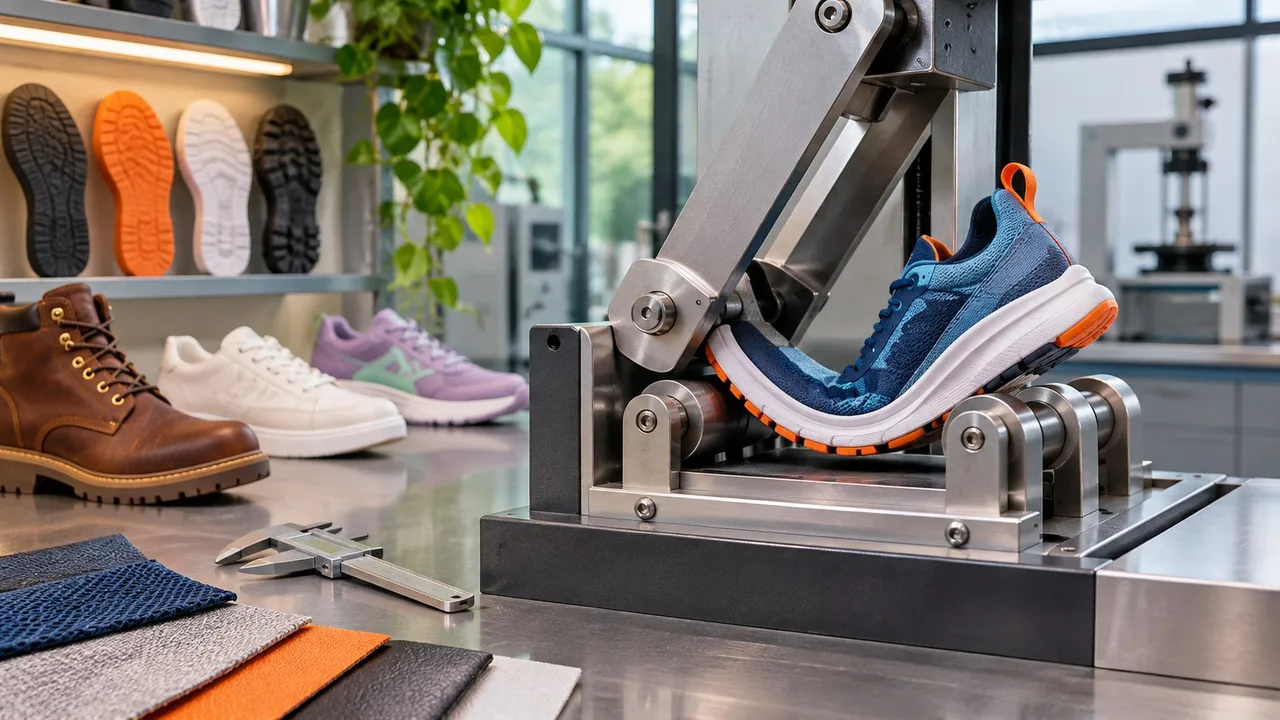
ISO 17707 specifies a method for outsole flex resistance under defined applicability, while ISO's footwear catalogue lists separate methods for whole-shoe flexing and upper components. Match the method to the construction and expected failure. A sole-material cut-growth test cannot answer every question about a complete shoe's upper creasing, bond fatigue or component interaction.
Define cycles, conditioning and failure criteria before testing. Check cracking, delamination, stitch damage, finish loss, hardware contact and functional change. If a fashion coating is expected to crease, use an approved appearance boundary rather than a vague requirement for “no change”.
Slip claims need particular discipline
ISO 13287 is a slip-resistance method for personal protective equipment footwear, and its scope is not a universal route for every fashion shoe. A slip-resistant claim can affect product classification and requires competent review of the destination rules, surfaces, contaminants and footwear type. Do not place the claim simply because an outsole feels grippy or a supplier provides a result from an unrelated method.
Other performance risks to map
| Failure mode | Possible evidence | Important boundary |
|---|---|---|
| Outsole wears or tears | Abrasion, tear and dimensional-stability methods | Material and tread geometry matter |
| Colour marks socks or clothing | Rubbing, bleeding or migration tests | Test final colours and adjacent materials |
| Fastener or heel fails | Attachment, fatigue, cycling or impact as applicable | Select by design and user risk |
| Water enters | Whole-shoe or material water test matched to claim | Water-resistant and waterproof are not interchangeable |
| Fit or comfort is inconsistent | Last control, size set, measurements and wear trial | Laboratory strength does not prove fit |
Chemical compliance follows the material map
Footwear can combine leather, textiles, polymers, adhesives, foams, metals, dyes and finishes. Build a destination-specific restricted-substance matrix by material and component. Use supplier declarations, material traceability and testing according to risk; avoid placing every chemical method on every component. Changes in leather source, plasticiser system, pigment, adhesive or metal finish can alter the testing rationale.
For EU consumer footwear, Directive 94/11/EC addresses labelling of materials used in the main components. Material labelling and chemical compliance are separate duties. A correct pictogram does not prove restricted-substance control, and a chemical report does not confirm that the upper, lining and outsole are labelled correctly.
Development gates that reduce late failures
Material and component gate
Approve critical materials with identity, physical characteristics, colour and chemical evidence. Confirm commercial availability and ageing risk before investing in multiple sample rounds.
Prototype and wear gate
Review fit, balance, flex point, pressure, fastening, outsole contact and visible ageing. Wear trials should follow a written protocol and record size, user, duration, surface and observations; they complement rather than replace standard tests.
Pre-production gate
Test the final material and construction set, close size-set and colour approvals, confirm labelling and freeze the process specification. Define any lot-level or periodic verification based on risk and supplier performance.
Bulk release gate
Inspect pair matching, size, workmanship, bonding, sole, heel, stitching, colour, components, labels and packing. Use quick functional checks that are defined and repeatable. Laboratory failures should already have been addressed; final inspection is not the first footwear quality testing stage.
Fit and size consistency need a separate evidence path
A footwear laboratory can measure components and strength, but fit is created by the last, pattern, material stretch, reinforcement, toe shape and construction process. Approve the base size on the intended last, then review a representative size set. Record internal length or other agreed dimensions, fitting observations and the method used to check left-right and pair consistency.
Wear trials should use a written brief: participant foot profile and size, socks, duration, surface, activity and the observations to record. A small informal trial cannot prove universal comfort, but it can expose heel slip, pressure, flex-point mismatch, rubbing, instability and material issues before bulk. Keep subjective comments separate from measurable defects and resolve both through design decisions.
- Control last identity, size marking and size conversion by destination.
- Check shrinkage or deformation after ageing where materials are sensitive.
- Define whether insocks, removable components or thick linings affect usable fit.
- Reapprove size and fit after a significant upper, lining, reinforcement or sole change.
Questions to resolve before accepting a report
- Is the tested shoe identical to the ordered material, construction, colour and factory?
- Does the method apply to this footwear type and the claim being made?
- Were ageing, size and test locations selected for the credible risk?
- Is the reported failure mode understood, not just the numeric result?
- What material or process changes require retesting?
- Who owns the destination compliance and final claim decision?
The result buyers should aim for
A strong footwear plan is not the longest laboratory quotation. It is a traceable set of decisions that tests the important interfaces, validates the final shoe and keeps legal claims inside their evidence. That approach supports better design choices and makes production problems easier to diagnose before shipment.
How Gnik can move this decision forward
Gnik can help footwear buyers map materials and failure modes, coordinate supplier questions and testing, and connect final inspection to the approved shoe rather than to a generic checklist.
Practical next step: send Gnik a product brief, target price and required performance level. Gnik can help turn it into a supplier-ready specification and evidence-gap review before quotation, sampling, order placement or shipment release, as applicable.