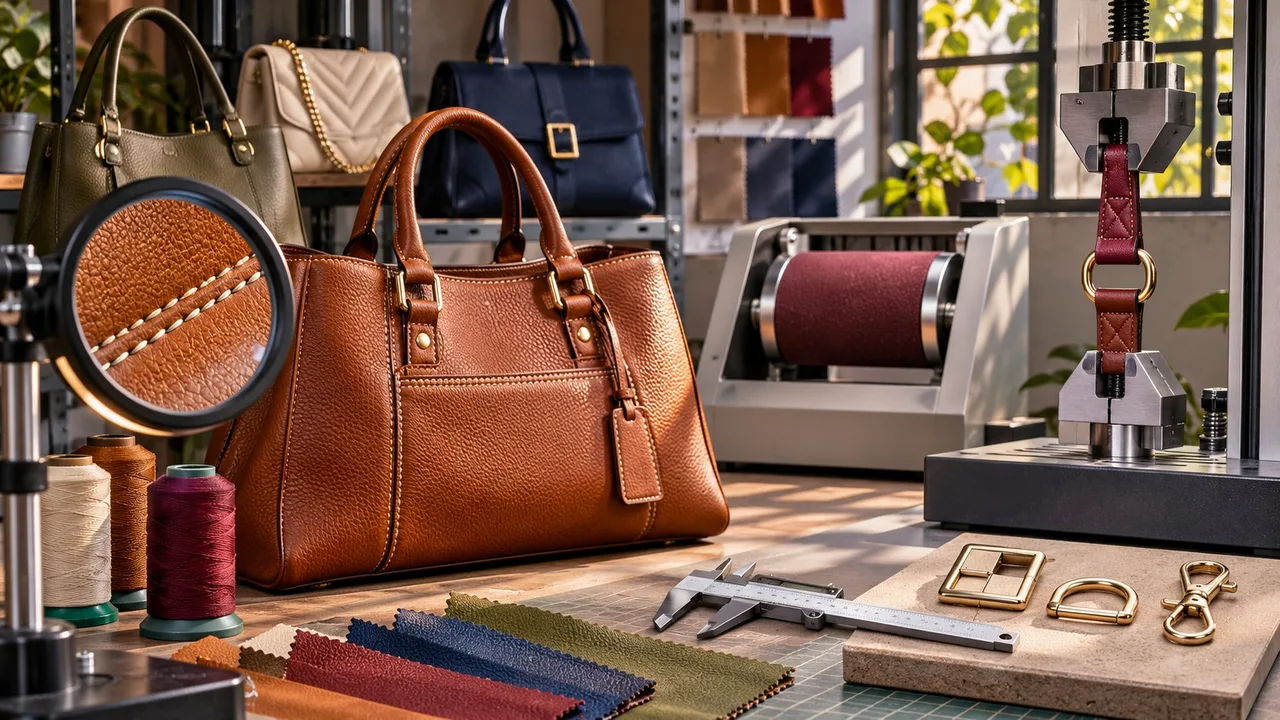
Translate technical performance into a buying decision
For category, product-development and quality teams, handbag quality testing is not only a technical question. It can affect product performance, return exposure, claim defensibility, consistency and landed commercial value. The useful decision is whether the proposed product, supplier and evidence route is strong enough for the intended market and channel—not whether another document can be added to the file.
Gnik’s role in execution
Gnik can connect the buyer’s intended use, price architecture and quality expectations to supplier-ready specifications, samples and evidence checkpoints. The buyer retains approval of the final specification, claims and market-specific compliance position.
A handbag usually fails at an interface: a strap meets the body, a zipper is forced around a curve, edge paint flexes at a handle, a rivet pulls through a thin reinforcement or a dark material marks light clothing. A beautiful approval sample may survive gentle handling but not the repeated loading, rubbing and climate of distribution and use.
The right plan begins with a construction stress map. It identifies what the user carries, how the bag is lifted, which components move, which surfaces touch clothing and how the product will be stored and shipped. Tests and inspection criteria can then be assigned to the risks that matter instead of copied from an unrelated bag.
Create a material and construction map
- Outer material, lining, interlining, reinforcement, foam or board, piping and edge finish.
- Handle, strap, webbing, anchor patch, seam, rivet, screw, ring, buckle and adjuster construction.
- Zipper type, chain or coil, size, slider, puller, stops, tape, curve and installation method.
- Decorative hardware, plating or coating, logo, feet, magnets, snaps, studs and any sharp or pinch points.
- Adhesives, inks, edge paint and surface finishes that may crack, migrate, smell or interact with packaging.
- Intended capacity, carry mode, user, destination, care, storage and any material or performance claims.
Identify high-stress zones directly on the technical drawing. A tote handle stitched into a reinforced panel behaves differently from a chain attached through a small eyelet. A backpack shoulder strap and a decorative clutch handle should not inherit the same load test. Product-specific construction and intended contents determine a credible load and cycle.
Handle, strap and seam testing should reflect the load path
| Question | Development check | What to record |
|---|---|---|
| Can the attachment carry the intended load? | Static, repeated lift or pull protocol | Load, duration/cycles, orientation and failure mode |
| Does the body material tear first? | Assembly test through reinforcement and seam | Tear, stitch, rivet pull-through or deformation |
| Does adjustment remain secure? | Buckle, slider or knot cycling | Slippage, damage and residual function |
| Is the seam itself strong enough? | Method such as ISO 13935 where applicable | Direction, construction, maximum force and failure location |
Define failure before the test: complete break, permanent extension, seam opening, material tear, rivet movement, unacceptable distortion or loss of function. A high force followed by severe permanent damage may not be a pass for a consumer product. Record the conditioning and test orientation so results can be repeated.
Zippers: test the installed system, not only the component
ASTM D2061 covers strength tests for zippers and zipper parts, including different holding-strength questions. Component evidence is useful, but installation can create new problems: tight curves, insufficient opening allowance, misaligned tape, weak top stops, thick seam crossings and pullers that hit the bag body.
- Approve zipper type, size, material, colour, slider, puller, lock, stops and tape.
- Check smooth operation in the completed opening at normal load and at difficult curve points.
- Assess lateral stress, stop security and puller attachment using a suitable method.
- Cycle the installed zipper and inspect teeth or coil, tape, slider, stitching and surrounding material.
- Confirm that lining and internal pockets cannot catch in normal operation.
Colour transfer and surface wear
ISO 105-X12 provides a method for dry and wet rubbing of textiles. Leather, coated fabric, edge paint and small coloured areas may need material-appropriate methods, but the decision remains the same: identify where colour can rub onto clothing, hands or adjacent panels and test the final commercial surface.
Straps and handles deserve priority because they repeatedly contact garments. Test edge ink as well as the face material. For colour-blocked bags, check transfer between dark and light components during storage and use. Packaging tissue can also pick up or redeposit colour, so include it in conditioning trials where relevant.
Hardware quality is more than plating colour
| Hardware risk | Control |
|---|---|
| Plating wears, tarnishes or spots | Define substrate and finish system; use approved colour master and relevant wear/conditioning |
| Buckle, ring or snap deforms | Component and assembly strength matched to load direction |
| Magnet damages surface or electronics | Design review, retention and use warning where relevant |
| Screw or rivet loosens | Torque, retention, locking method and assembly process control |
| Sharp edge or burr contacts user | Critical design and 100% workmanship control |
Apply destination-specific restricted-substance controls to metals, leather, polymers, coatings, adhesives and dyes. A plated buckle report does not cover a zipper pull, rivet and magnetic closure unless the material and supplier grouping is justified. Keep the component map linked to the evidence file.
Moisture, odour and mould prevention
Leather, cellulosic boards, cotton linings and packaging can absorb moisture. Control material condition, drying and storage; inspect for odour and visible growth; and avoid treating desiccant as a cure for wet product. Define safe packaging moisture decisions with competent technical input because acceptable readings depend on material and instrument.
Validate the pack through the expected route. Tight polybag closure in a humid factory, long sea transit and hot container exposure can create a different risk from air freight. Coatings and adhesives should be sufficiently cured before packing. Product surfaces should not touch print, metal or protective films that can stain or imprint them.
A stage-by-stage control plan
Development sample
Confirm usability, dimensions, capacity, carry comfort, opening access, pocket function, balance and the initial stress map. Compare alternative reinforcements or attachments before appearance approval freezes the construction.
Pre-production sample
Use final materials, colours, hardware and packing. Run product-specific load, cycling, rubbing, adhesion, wear and chemical checks according to the risk plan. Approve a signed sample and visual defect board for edge paint, stitching, grain, shade, wrinkles and hardware.
Inline and final inspection
Check incoming components and critical operations early: reinforcement placement, seam allowance, rivet setting, edge preparation, paint layers and zipper installation. Final inspection then confirms identity, dimensions, workmanship, function, pair or set consistency, labels and pack. Defined quick tests can reveal escapes, but they do not replace pre-production validation.
Questions every handbag specification should answer
- What is the intended load, and which attachments carry it?
- Which surfaces will rub against clothing or against other parts of the bag?
- What are the exact materials, sources and finish systems for every component?
- Which visual variations are acceptable for natural leather or handmade work?
- Which test conditions and limits represent this design and destination?
- How will material, component or process changes trigger reassessment?
The quality outcome
Effective handbag quality testing follows the actual design. It validates the stressed interfaces, controls colour and finish at contact points, and protects the product through distribution. This creates evidence that explains why the bag should perform—not a generic inspection list that only confirms how it looked on one day.
How Gnik can move this decision forward
Gnik can help handbag buyers build product-specific specifications, coordinate component and assembly checks, and align development, factory control, final inspection and shipment protection.
Practical next step: send Gnik a product brief, target price and required performance level. Gnik can help turn it into a supplier-ready specification and evidence-gap review before quotation, sampling, order placement or shipment release, as applicable.