The food buyer’s commercial decision
For private-label, retail and foodservice buyers, nuts, seeds and dried fruit is not only a technical question. It can affect market access, shelf-life integrity, claim accuracy, recall readiness and repeat supply. The useful decision is whether the proposed product, supplier and evidence route is strong enough for the intended market and channel—not whether another document can be added to the file.
Gnik’s role in execution
Gnik can translate the buyer’s product and market requirements into a controlled supplier brief, coordinate the required evidence and expose unresolved decisions before sampling or order commitment. Regulatory acceptance, laboratory interpretation and formal legal decisions remain with the responsible qualified parties.
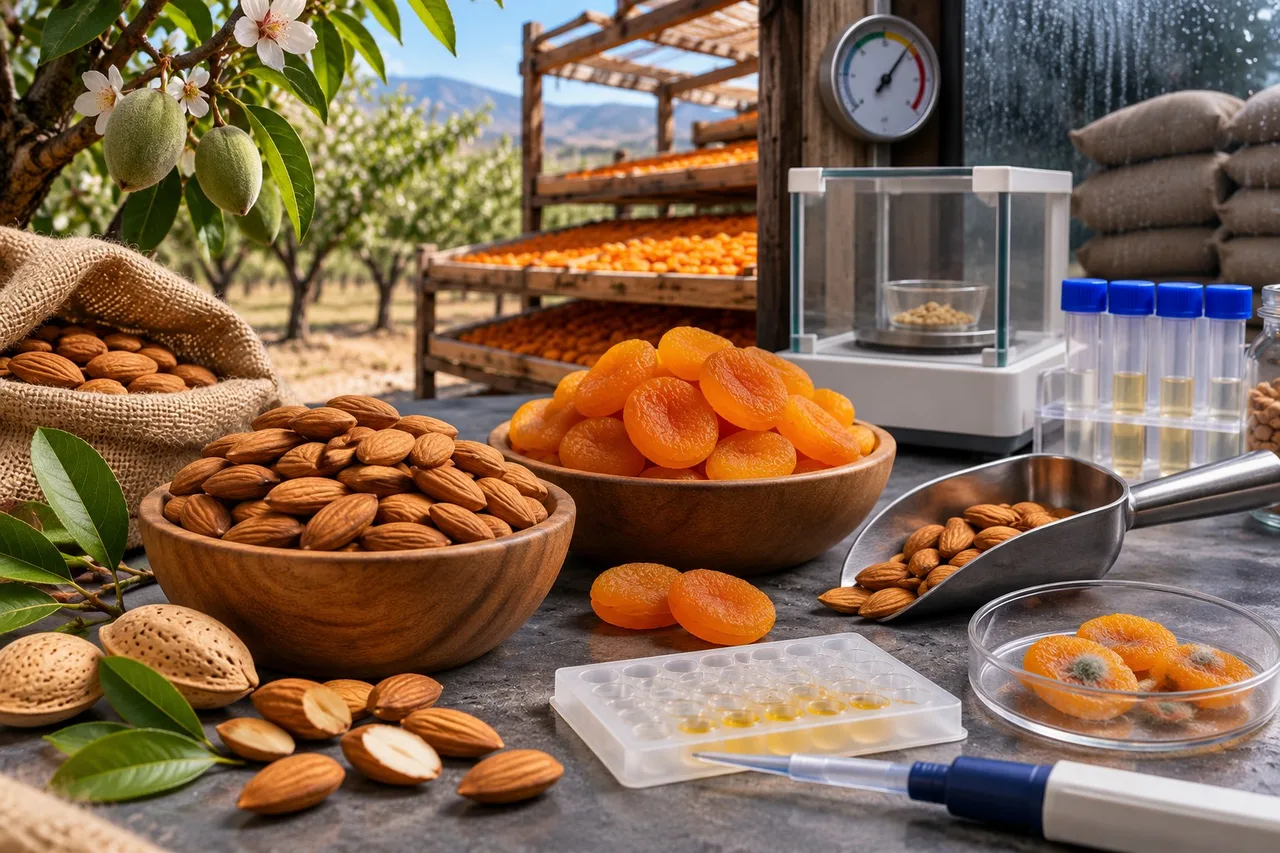
For procurement teams researching nuts seeds dried fruit export controls, the central issue is not a document or test in isolation. It is whether the commercial decision is supported by product-specific, market-specific and lot-specific evidence. Nuts, seeds and dried fruits combine agricultural, low-moisture and storage risks. Salmonella may persist; aflatoxins can be heterogeneous; sulphites may need declaration; insects and rancidity can emerge during storage. Controls should be commodity- and origin-specific, with lot formation and sampling designed before material is mixed, roasted, coated or repacked.
Why this decision matters
Food safety and quality controls must reflect the product's intrinsic properties, process, package, storage and intended use. A generic certificate or copied HACCP plan cannot demonstrate that the weakest step in a particular recipe and pack has been identified and validated.
A useful system leaves a short audit trail: the question asked, evidence reviewed, limitation identified, decision made and trigger for reassessment. This protects both the buyer and a capable supplier from later reinterpretation.
A workable control sequence
1. Separate raw and ready-to-eat routes
Define whether a validated kill step occurs and how treated product is protected from raw material, dust and rework.
2. Layer chemical and storage controls
Set moisture, water activity, toxin, sulphite, infestation, oxidation and temperature expectations appropriate to the commodity and market.
3. Identify the safety-critical and quality-critical steps
Separate controls that prevent a safety failure from controls that protect sensory, legal and commercial acceptance.
4. Validate the worst credible case
Use the most difficult recipe, particle size, fill weight, container, line speed or storage condition rather than the easiest development sample.
What a defensible evidence pack contains
Evidence should be current, attributable and connected to the exact commercial product. The following records are normally more useful than a general assurance statement:
- Harvest, drying, sorting, storage, fumigation and treatment records linked to lot identity.
- Representative toxin and microbiological results plus infestation and sensory release checks.
- Validation or process-authority evidence tied to recipe, equipment, pack and operating limits.
- Routine monitoring and capability records showing the validated limits are consistently achieved.
Where programmes usually fail
- Relying on visual sorting to manage invisible mycotoxin or pathogen risk.
- Treating roasted material as protected while it is cooled or packed in a shared raw environment.
- Using a generic food-safety plan that does not describe the actual product, line or post-process exposure.
When responsibility is vague, evidence is requested repeatedly but never formally accepted. A defined owner, acceptance rule and escalation path turn the same information into a usable commercial control.
A short procurement scenario
Consider a buyer preparing a private-label launch who receives a confident supplier assurance but later discovers this weakness: relying on visual sorting to manage invisible mycotoxin or pathogen risk. At that point the choice is no longer simply pass or fail. Packaging, production slots, freight and launch commitments may already be exposed. A stronger sequence would have made the issue a pre-approval question and required harvest, drying, sorting, storage, fumigation and treatment records linked to lot identity.
The buyer should pause the affected decision, preserve the exact product and lot identity, and apply the first control question: separate raw and ready-to-eat routes. If the evidence supports approval, the reasoning and boundaries should be recorded. If it does not, the team can reformulate, change the source, increase verification or revise the launch plan while alternatives still exist. This is not bureaucracy; it is the commercial value of making uncertainty visible early.
Signals to monitor after approval
Approval should begin a monitored operating period, not end the technical discussion. Useful indicators include:
- Changes that trigger review or revalidation.
- Critical-limit and process-monitoring deviations.
- Line or recipe differences outside validation boundaries.
A better implementation sequence
1. Revalidate after material changes to recipe, equipment, pack or process.
Tie the gate to a record, result or explicit approval so progress is visible without relying on personal assurance.
2. Map the exact formulation, process sequence, pack and intended use.
Resolve any exception while alternatives still exist, before production or booking removes flexibility.
3. Identify the weakest safety and quality controls in the system.
Use accumulated evidence to adjust verification depth and record why the control became stronger or lighter.
What this means for buyers and suppliers
For buyers, the control creates an escalation path that is firm without being arbitrary. The supplier knows what is missing, who reviews it and what evidence would allow the decision to move forward.
For suppliers, defined acceptance rules reduce subjective rejection. Results, deviations and corrective actions can be discussed against agreed evidence rather than personal preference or last-minute urgency.
Key takeaway
The buyer and supplier should be able to explain the same approval in the same terms. Shared product facts, explicit evidence and named accountability are the foundation of that alignment.
How Gnik can move this decision forward
Practical next step: send Gnik a product specification, ingredient list and intended destination markets. Gnik can help turn it into a supplier-evidence and market-readiness action list before quotation, sampling, order placement or shipment release, as applicable.